Autism and heroism - The day my 14-year old son guided hundreds of lives to safety in a 6.4m earthquake
Dec 08, 2025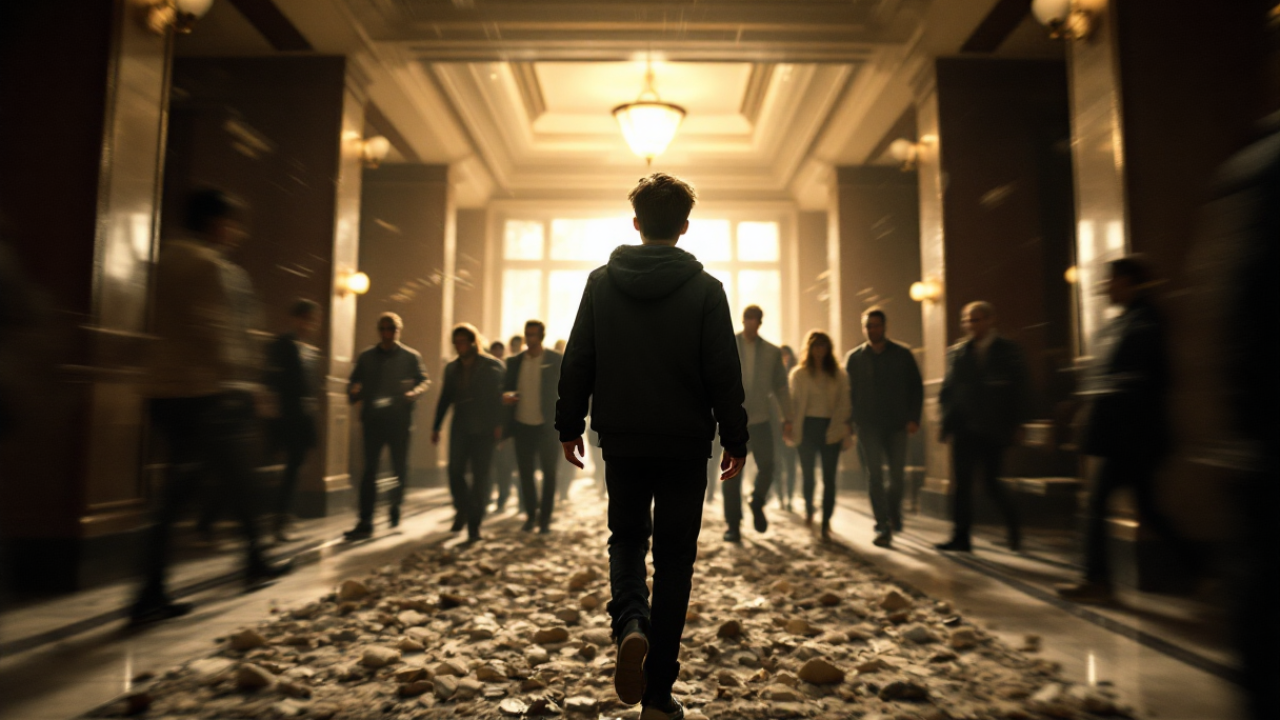
My son is autistic. He’s now 15.
And during a 6.4 magnitude earthquake in Bangkok, in a thirty-plus–storey hotel, he guided hundreds of people safely out.
His name is Banjo. And nothing about this story is embellished.
His autism wasn’t an obstacle. It was the reason people evacuated safely.
When the quake hit, we were scattered across this huge high-rise.
My daughter was on the 33rd floor. I was lower down on the 27th floor.
Banjo was with me.
When the walls started to sway and groaned, the ceiling lights began to swing, and the screaming began, every cell in my body told me to run up to my daughter on the 33rd floor.
Every mother will understand that instinct.
But Banj, fourteen, autistic, terrified and still somehow composed put his hand on me and said, firmly:
“Mum. Kitty is safe, We go down now.”
He anchored me in a moment where I could have made the worst decision of my life.
Then he turned outward and took command.
He blocked the lifts as adults in full panic tried to force their way in.
He held his arm out, steady and certain, and redirected them towards safety.
He gave clear instructions to guests who didn’t speak English, using gestures, tone and absolute confidence.
He found the correct stairwell faster than trained staff did.
And then he started moving.
Voice loud, clear, and firm:
“Follow me. Slow down. One line. Watch out for each other. Keep going.”
Hundreds of adults listened to him.
Not because he was loud.
Not because he was authoritative.
Because in a collapsing building he was the only one who sounded certain.
His autistic traits lit the path everyone else could not see.
Down we went, ten, twelve floors, through a stairwell cracking under stress.
People crying, screaming.
People shoving.
People frozen in terror.
People unable to understand each other’s language.
And there was Banj, counting people, scanning faces, checking for blockages, slowing the frantic and encouraging the terrified.
Then came the moment I will never, ever forget.
Midway down, the stairwell became unsafe.
The structure was failing.
I would have kept descending because that’s what fear does, it narrows your vision to the path in front of you.
But Banj stopped.
He opened an internal door into the hotel, a move no adult around him would have dared to make and immediately understood the route we needed to take.
His spatial awareness.
His pattern recognition.
His ability to process movement, structure, safety and risk in real time.
He turned to the crowd, over a hundred people behind us, and said:
“We need to switch course. Follow me. Stay together.”
And here is the miracle:
Hundreds of adults crossed through a collapsing building because a fourteen-year-old autistic boy understood the geometry of danger better than any of us.
He guided wave after wave of people through the internal hotel, down a secondary escape route and out into safety.
Those who couldn’t understand his words understood his tone and his certainty.
This wasn’t luck.
This wasn’t chance.
This was neurodivergent brilliance under pressure.
His wiring made him the calmest leader in the room.
Hope — Imagine if every autistic child grew up knowing their mind is powerful.
Banjo was diagnosed at four-and-a-half.
Before diagnosis, we were told all the usual things:
Be less intense.
Be more flexible.
Act more “typical.”
Try to be easier.
Can you imagine?
We nearly allowed a world of misunderstanding to sand down the very traits that saved lives:
His clarity.
His spatial reasoning.
His hyperfocus.
His problem-solving.
His deep, practical empathy.
His ability to cut through panic with simple, actionable language.
Imagine if we’d crushed those gifts.
Imagine if he’d learned to doubt himself.
Imagine if he’d learned to wait for permission instead of stepping forward.
Instead, he grew up understood, not corrected.
Trusted, not doubted.
Seen, not shamed.
So when the building shook, he didn’t hesitate.
He stepped into who he already was.
Because a little laughter keeps the tears away.
Neurotypical response to an earthquake:
Run, scream, drop belongings, shout "Where’s my phone?" and film for content, then tag #blessed.
Autistic response:
Assess building stability.
Block unsafe lift use.
Initiate multilingual evacuation protocol.
Re-route hundreds of strangers through a collapsing hotel with the energy of someone reorganising the pantry.
I swear he saved lives with the exact tone he uses to tell me I’ve loaded the dishwasher wrong.
This isn’t just a story. It’s a line in the sand.
Banjo is my son.
I watched him emerge from that building covered in dust and sweat, shaking but composed, asking if everyone got out before asking if we were okay.
I will never be the same. And I refuse to raise him in a world that still thinks autistic children need fixing.
So this isn’t a story I’m sharing. It’s a declaration of value.
At 🟠 the neurovision group, we’re building the spaces where autistic children, and the adults they become, grow up knowing their wiring is magnificent.
Where intensity is celebrated.
Where calm logic is respected.
Where deep focus is seen for what it is:
a huge strength in waiting.
If you’re autistic, raising autistic, teaching autistic or simply loving someone whose mind works differently, join our online community, you’re welcome here.
We see what the world too often misses. And we will prepare our children long before the ground shakes.
With love, pride and still-trembling hands,
A very proud mum
🟠 the neurovision group
All Kinds of Minds™ — especially the ones steady enough to guide the rest of us home.