All Kinds of Minds™ in Education
Education doesn't have a shortage of capable minds.
It has too many conditions that make capability harder to see.
From learners finding their way through education to the people teaching and supporting them, we help education organisations recognise capability differently — and remove unnecessary friction around how people learn, teach and participate.
People. Process. Place.
Book a conversationWe help education settings read learners more accurately, so more brilliance can be seen, supported and built on.
Our work spans primary, secondary, FE and vocational settings. .
Where we are working
Our education work is active and growing. We are not offering generic CPD. We are working with institutions ready to move from awareness into embedded, evidenced practice change.
Our current education work includes:
All Kinds of Minds™ in Education - Leeds College of Building
A whole-institution programme rolling out across all 144 tutors and assessors, preceded by a Friction Scan diagnostic. LCB is the founding institutional partner in a model designed to be evidenced, repeatable and scalable across the FE and vocational sector.
All Kinds of Minds™ in Construction - Wates
The external-facing programme connecting apprentices and their employer managers around a shared language for cognitive strengths.
Education pilots
We work with a small number of schools, trusts and FE settings at any one time to keep the work grounded, practical and properly supported. If you are interested in bringing this into your setting, the right starting point is a conversation, book a call below.
Why so much brilliance is still being missed
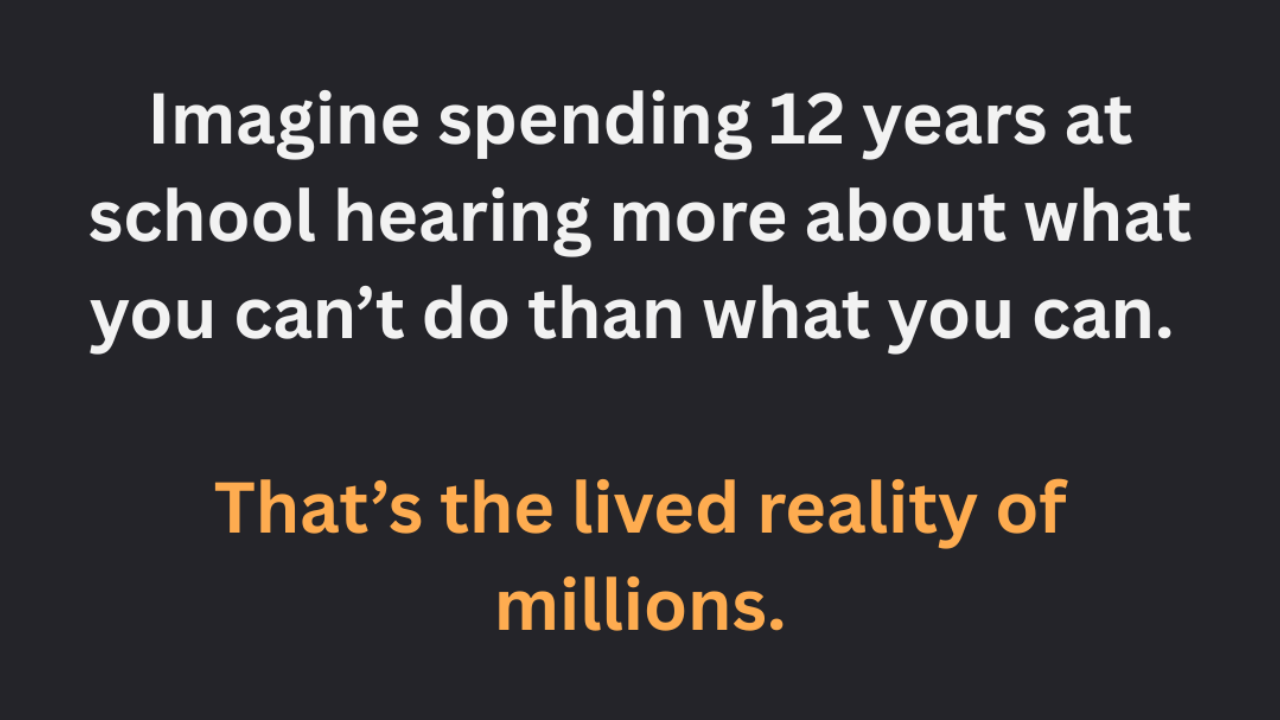
Some children move through 12 years of education hearing more about what they cannot do than what they can. ND children receive around 20,000 more negative comments than their neurotypical peers, before they're 10 years old.
Not because they lack intelligence or potential. They have both.
But because the systems around them are often built to recognise only a narrow band of performance.
When that happens, children are misread.
- Access difficulty gets misread for low ability.
- Distress gets misread for defiance.
- Inconsistency gets misread for lack of effort.
- Silence gets misread for disengagement.
- Difference gets misread for deficit.
That is not a small misunderstanding. It shapes identity, confidence, attainment, belonging and the future paths young people believe are open to them.
What educators are telling us
Educators don't need convincing that inclusion matters. They need the confidence, clarity and practical tools to deliver it well in real classrooms, under real pressure. Again and again, we hear a similar pattern:
Staff care deeply. They are trying. They are noticing difference. But many do not feel fully equipped to interpret what they are seeing or respond with confidence in the moment.
They are telling us they need more than awareness.
Too often, educators are expected to carry the responsibility of inclusion without enough shared language, training or system design to make it feel clear, consistent and doable.
We help with this.
That is why our work focuses not only on learner need, but on educator confidence, practical application and the wider conditions that help inclusion hold.
If you'd like to explore your current setting yourself, take the quiz below, apx 3 mins.
Why this matters
This is a future issue.
When schools over-reward one narrow kind of success, we don't only fail some children. We narrow the human breadth of brilliance available to society.
We lose makers, builders, growers, carers, practical thinkers, pattern spotters, designers, innovators and deep-feeling minds whose strengths may not always arrive in the most easily measured form.
We lose children who might have become extraordinary adults if someone had recognised their diverse strengths properly and early enough.
And then we call the damage 'standards'.
A system that can only recognise one kind of success is not rigorous.
It is limited.
Our perspective
We start from a different question
We don't start with: 'What is wrong with this learner?'
We start with: 'What is the environment doing that is making learning, participation and recognition harder than they need to be?'
That shift changes everything.
Because the issue is often not absence of ability.
It is blocked access.
And access difficulty is not low ability.
How we work with education settings
Every setting is different, so we don't begin with a predetermined programme.
We start by understanding where capability is being blocked and what learners, staff and leaders are experiencing.
From there, we shape the right response — from focused development through to wider organisational change.
Our work is practical, evidence-led and designed around People. Process. Place.
The starting point is simple: a conversation about what you're noticing.
Who we work with



Parents and families
We bring language, insight and advocacy to experiences many families know intimately but are often left to explain alone.
Join our online community
What makes us different
This is not generic awareness training. And it's not another way of asking already overstretched staff to compensate harder inside the same broken conditions.
Our work is different because it:
- Names what is already there
- Explains why it gets blocked
- Shows how to unlock it
It combines lived experience, inclusion strategy, practical systems thinking and a strengths-informed lens that helps settings move beyond labels into better design.
We don't ask young people to become smaller to fit the room.
We help the room become more capable of holding different minds well.
Why this matters now
Education settings are under pressure to improve outcomes, strengthen attendance, support wellbeing, manage transitions, reduce exclusions, retain staff and build trust with families.
But those outcomes are harder to achieve when children are being misread at the level of everyday interpretation.
The cost of misreading is not abstract. It shows up in behaviour, disengagement, anxiety, masking, attendance, fractured relationships, avoidable escalation and lost confidence.
The opportunity is not to add more strain.
It is to create better fit.
The future needs more kinds of minds, not fewer
Learning environments that work for diverse minds do not just support inclusion. They improve engagement, behaviour, wellbeing and outcomes for everyone.
When educators are given the right understanding, language and tools, inclusion becomes more confident, more consistent and more sustainable.
Ready to explore what this could look like for your setting?
Bring All Kinds of Minds™ in Education into your setting
Whether you are looking for a keynote, workshop, learner session, transition support or a deeper diagnostic conversation, we would love to hear what your setting is noticing and where the work feels stuck.
Book an exploratory conversation to chat about anything we've shared that interests you.
BOOK A CONVERSATION